


What does it really mean to design for disassembly?
Circular design brings the principles of the circular economy directly into the design process. It is not just about shape, comfort or material selection, but also considers how a product is manufactured, used and, at the end of its life cycle, disassembled.
Designing with this approach means paying close attention to the relationship between the different components and to the possibility of separating them. In the case of seating, this can involve the frame, padding, upholstery, base and the systems used to assemble the various parts.
In the sustainable furniture sector, this approach is particularly relevant because product design can combine material awareness, customisation, disassemblability and life cycle considerations.
Folda and Hibi are two examples of this approach applied to seating. The former is a lounge chair designed without adhesives, featuring removable covers and an easy-to-disassemble structure. The latter is a fully upholstered, removable-cover and disassemblable chair, available in different versions and configurations.
To explore configurations, finishes and quantities for your project, request a quotation.
What is circular design and how does it change the way we design?
Circular design considers a product as part of a broader cycle that extends beyond its use phase. The design process takes into account materials, components and the possibilities for separating the product into its individual parts.
The concept is closely linked to the circular economy, a model that aims to keep products and materials in use, reduce resource waste and integrate sustainability principles into the design process.
When applied to furniture, this means considering aesthetic, functional and construction-related aspects together.
| Linear model | Circular approach |
|---|---|
| The product is considered primarily during its use phase | The product is considered throughout its entire life cycle |
| Components can be difficult to separate | Component separation is considered during the design process |
| The product is treated as a single unit | Individual components are also taken into account |
| End-of-life considerations are addressed after use | End-of-life is considered from the design stage |
| Sustainability may focus on material selection | Materials, construction and disassembly are considered together |
A recyclable material alone does not automatically make a product circular. The way it is used and connected to other materials is equally important.
In the case of a seating product, circular design can therefore take into account:
- Durability and intended use;
- Materials and components;
- The possibility of separating different parts;
- Removable upholstery covers;
- Disassembly;
- The possibility of working on individual components;
- Material management at the end of the product's useful life.
In the PLACES catalogue, circularity is also addressed through recycled and recyclable fabrics and through disassemblable products such as Folda and Hibi.
What does designing for disassembly mean?
Designing for disassembly means considering, from the very beginning of the design process, how a product can be opened and separated into its individual parts.
Design for Disassembly is not simply about making furniture that can be taken apart. It also requires careful consideration of the relationships between components and the materials they are made from.
A design approach focused on disassembly can take at least the following elements into account.
1. Accessible joints
Screws, fittings and fasteners should be accessible without damaging the product.
2. Reversible connections
Mechanical connections are generally easier to manage than adhesives and permanent bonding systems.
3. A controlled number of operations
A disassembly process that is too lengthy or complex may not be economically viable.
4. Material separation
Metal, wood, fabric, polyurethane and plastic should be separable so that they can be directed towards the appropriate recovery and recycling processes.
5. Replaceable wear parts
Upholstery, cushions, bases and other exposed components should be assessed individually.
6. Instructions and documentation
Technical drawings, bills of materials and disassembly instructions make the design principles verifiable.
7. Damage-free disassembly
Recovered components should retain useful properties for reuse, repair or further processing.
Why is disassembly relevant to contract projects?
In contract projects, seating must meet functional, aesthetic and design requirements. The possibility of configuring the same product in different ways can be particularly important when it needs to fit into a variety of environments.
PLACES products are designed for residential, office, hospitality and contract settings. The collection includes different types of seating and furniture, embracing the concept of disassemblable furniture.
In this context, disassemblability can be considered alongside other factors:
| Design requirement | Aspect to consider |
|---|---|
| Customisation | Upholstery, colours and finishes |
| Comfort | Seating type and configuration |
| Versatility | Availability of different configurations |
| Product maintenance | Removable covers and disassembly |
| Contract projects | Adaptability to different environments |
| Materials | Possibility of separating components |
The interest in disassembly therefore concerns not only the final destination of a seating product, but also the way it is designed and manufactured.
How to integrate circularity into the design process
Circularity can be taken into account as early as the product selection stage.
For architects and interior designers, this means translating sustainability into tangible features that can be assessed: materials, upholstery, construction systems, configurations and disassembly possibilities.
Folda incorporates these principles through its adhesive-free construction, removable covers and the possibility of separating the metal frame from the padding. Hibi interprets them through removable upholstery, disassemblability and component separation.
Folda: a lounge chair designed without adhesives
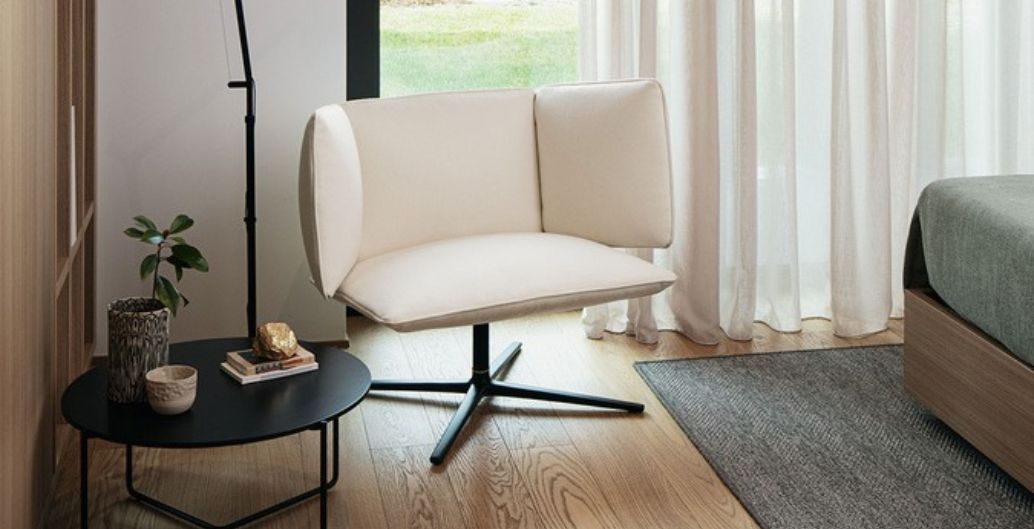
Folda is a lounge chair designed by Alessandro Stabile for Milani PLACES.
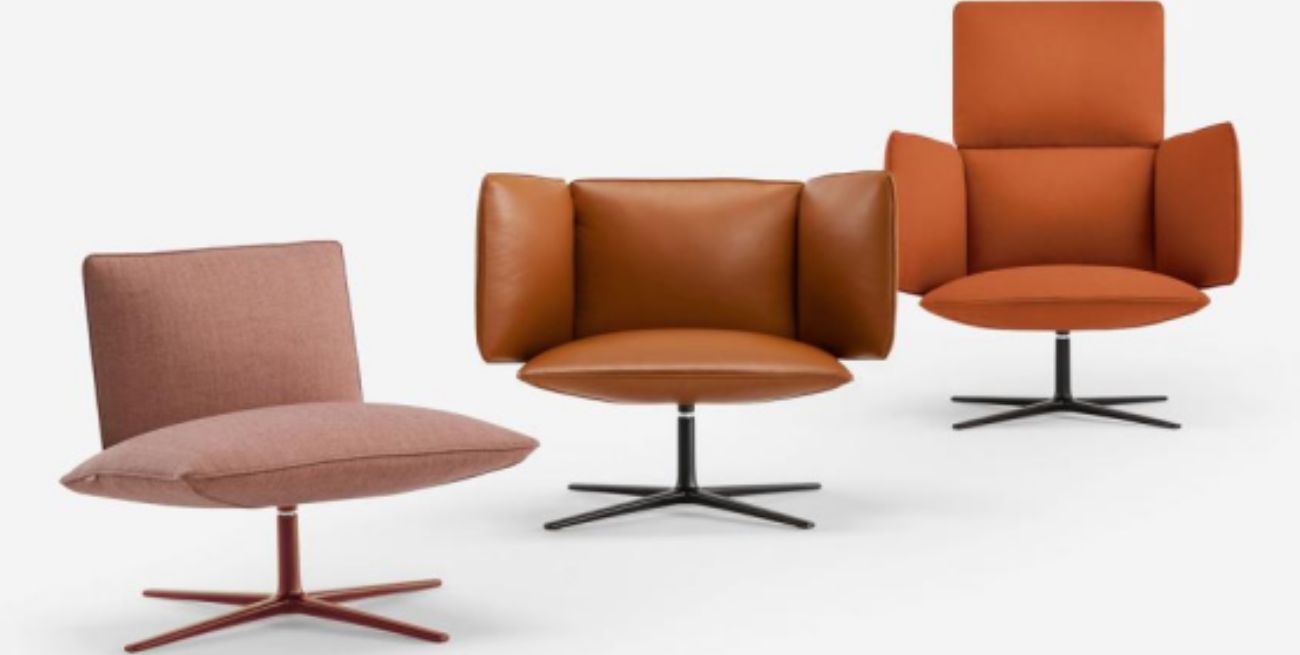
The design reinterprets the concept of the cushion, making it the central element of the composition. The seat, backrest, armrests and headrest are created using rectangular cushions arranged according to unconventional proportions.
Folda's design also focuses on how the product is manufactured and disassembled.
The lounge chair:
- Uses no adhesives;
- Features removable covers;
- Can be easily disassembled;
- Allows the metal frame to be separated from the padding.
The padding is integrated through the fabric using a puzzle-like approach. The production process is also organised according to a modular system: two, four or five cushions can be combined to create the different available configurations.
Hibi: a fully disassemblable armchair
Hibi is an armchair designed by Margherita Rui for Milani.
The design draws inspiration from the folds of origami: its slim shell recalls delicate, defined folds, with the aim of combining visual lightness and structural strength.
Hibi is designed to fit into contract and residential environments, workplaces and domestic settings.
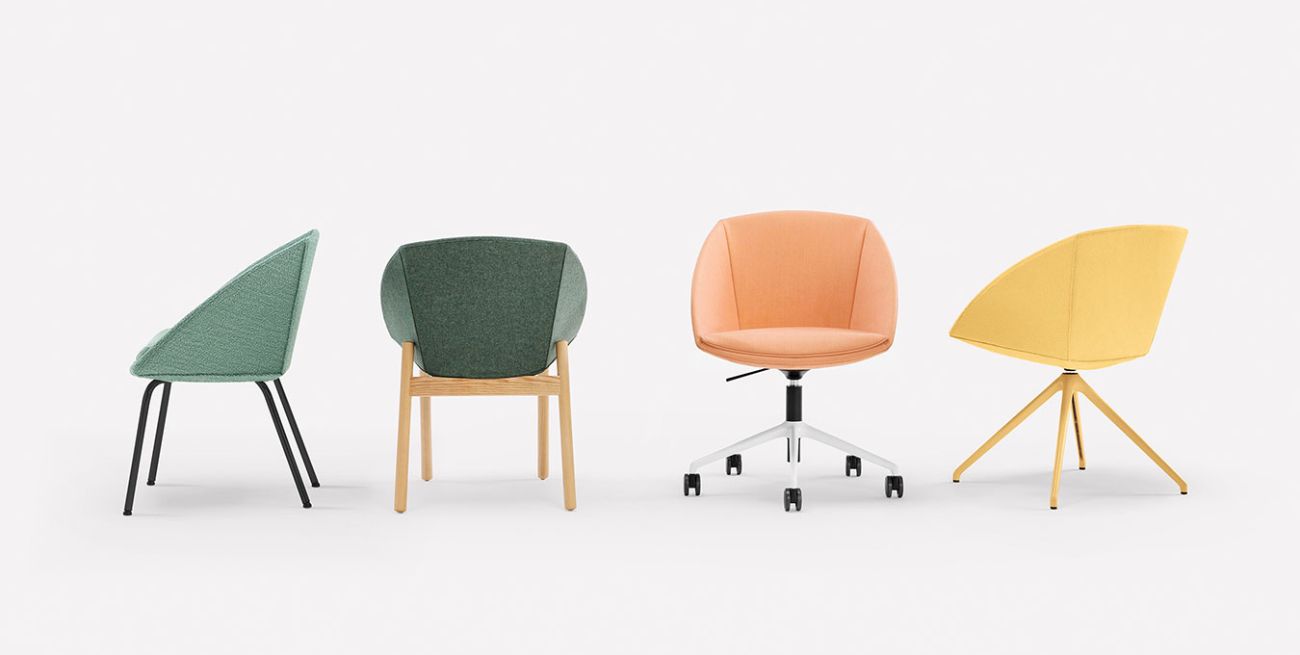
The collection is available in two versions:
- Hibi Light, with a more minimalist design;
- Hibi Soft, featuring an upholstered cushion with removable covers, available in matching or contrasting colours.
The chair can also be configured with different bases, including a swivel base, a spider base with castors and a four-leg base in metal or wood.
From a circular design perspective, Hibi is a chair with removable upholstery and a disassemblable structure.
Its components can be separated at the end of the product's life cycle, while the studs securing the upholstery can be unscrewed, recycled or reused.
Folda and Hibi compared
Folda and Hibi approach circularity from the perspective of two different types of seating.
Folda builds its identity around the arrangement of cushions and the separation between the frame and padding. Hibi, on the other hand, integrates disassemblability into the structure of the armchair and the possibility of separating its individual components.
Furthermore, the upholstery features of both Folda and Hibi include removable covers, customisation options and a variety of fabric choices. These features allow both seating solutions to be adapted to the aesthetic and functional requirements of each project.
From principle to project
Circular design starts with the design process itself. It is not just about what happens when a product reaches the end of its useful life, but also about how it is conceived, manufactured and configured.
Designing for disassembly means considering components as parts of a system and assessing, from the outset, how they can be separated.
FAQ
Can Folda and Hibi be refurbished or repaired?
Yes. Milani's official documentation presents both Folda and Hibi under its "Circular by Design" approach, highlighting the possibility of refurbishing and repairing the products.
For Folda, Milani also specifies that 100% of its constituent materials can be recovered. For Hibi, the company states that the chair can be easily refurbished and repaired and that 100% of its materials can be recovered.
Which recycled fabric has been used for Folda and Hibi?
In 2026, Milani introduced Folda and Hibi upholstered in Cura Loop, a fabric made entirely from textile waste through a textile-to-textile recycling process.
The material is also fully recyclable. This proposal was presented by Milani as part of its collaboration with Gabriel and its ongoing commitment to sustainability.
Which colours are available for the bases of Folda and Hibi?
The metal bases of Folda and Hibi are available in 11 finishes: chrome, black, white, bronze, copper, yellow, red, blue, oyster white, basalt grey and dark green.
Hibi is also available with a wooden base in natural, tobacco and black finishes.
To identify the most suitable configuration for hospitality, office, educational or other shared environments, request a quotation.